




Once viewed primarily as a technical function, cybersecurity now influences decisions across every level of an organisation. From safeguarding digital infrastructure to managing risk and maintaining stakeholder trust, cybersecurity leaders are increasingly expected to navigate both technical complexity and organisational realities.
Recognising this shift, Singapore Management University (SMU) has designed the Cybersecurity track within its Master of IT in Business (MITB) programme to better prepare professionals in navigating and tackling increasingly complex cyber challenges.
At the helm of this track is SMU Associate Professor of Computer Science (Practice) Shar Lwin Khin, whose research sits at the intersection of software engineering, artificial intelligence (AI), and cybersecurity. As the Director of the MITB (Cybersecurity) track, he is keen on training a new generation of cybersecurity leaders who are as comfortable in the boardroom as they are in technical environments.
“Cybersecurity today is not just a technical problem. It’s a business, regulatory, and strategic issue,” he says. “We need professionals who can understand the threats as well as design, lead, and justify security initiatives within organisations.”
A career shaped by systems and their vulnerabilities
Trained in software engineering, Assoc Prof Shar’s early work focused on how complex systems are designed, tested, and made reliable. As he explored automated programme analysis and secure software development during his postgraduate studies, he became increasingly aware of how a single software flaw could have cascading effects.
One example was the Heartbleed vulnerability, where a relatively small coding error in a widely used security library exposed sensitive information from servers around the world.
“What struck me was that this was not caused by a sophisticated attack, but by an overlooked implementation flaw that propagated across countless systems and organisations,” Assoc Prof Shar explains.
“It reinforced my belief that security must be engineered systematically throughout the software development lifecycle.”
That realisation has since shaped much of his research and teaching, as his interest shifted towards cybersecurity and AI-driven solutions.
Since joining the SMU School of Computing and Information Systems (SCIS) in 2019, Assoc Prof Shar has built a research portfolio that combines conventional software engineering techniques with AI to address cybersecurity problems. He appreciates the entrepreneurial spirit, academic freedom, and institutional support of the University, which has allowed him to keep pushing boundaries in research.
“Cybersecurity is a field where the stakes are high and the landscape constantly evolves,” he says. “What keeps me motivated is the opportunity to contribute to real systems, real protection, and real people.”
Designing the SMU MITB (Cybersecurity) track for real-world impact
That same focus on practical impact carries into Assoc Prof Shar’s role as Director of the SMU MITB (Cybersecurity) track. The programme is structured to address a persistent gap in the field: the disconnect between technical expertise and business decision-making.
He describes his role as a mix of strategic and hands-on work, designing and refreshing the curriculum, engaging with industry partners, supervising student capstone projects, and collaborating with faculty to integrate technical depth with business acumen.
The Cybersecurity track curriculum reflects this dual focus. Students develop capabilities in areas such as secure software development, cloud security, and AI-driven analysis. At the same time, they learn to translate technical risks into organisational priorities, balancing cost, usability, and compliance. The MITB’s experiential learning framework also helps students build the judgment required to operate in complex organisational contexts.
“What excites me most is the opportunity to shape a new generation of cybersecurity leaders who are fluent in both technology and strategy,” says Assoc Prof Shar. “Seeing our students go on to lead security initiatives in banks, government, and tech companies would be deeply rewarding.”
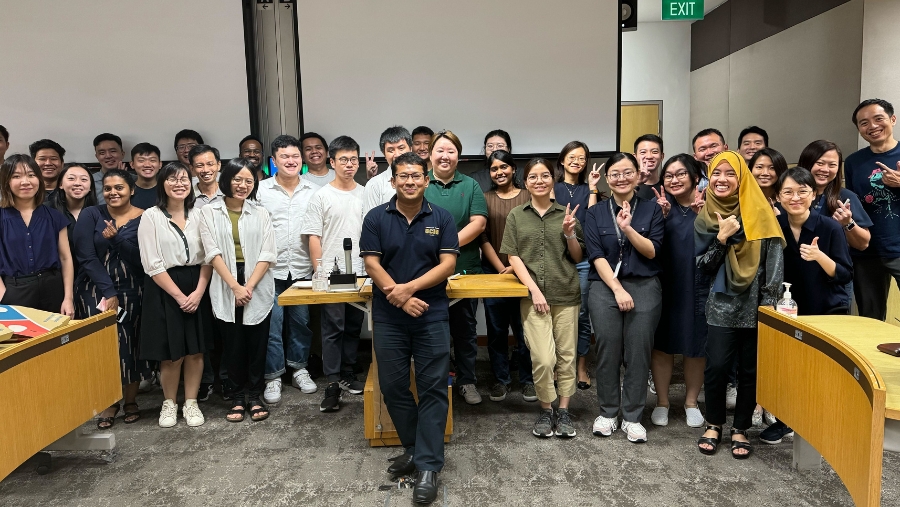
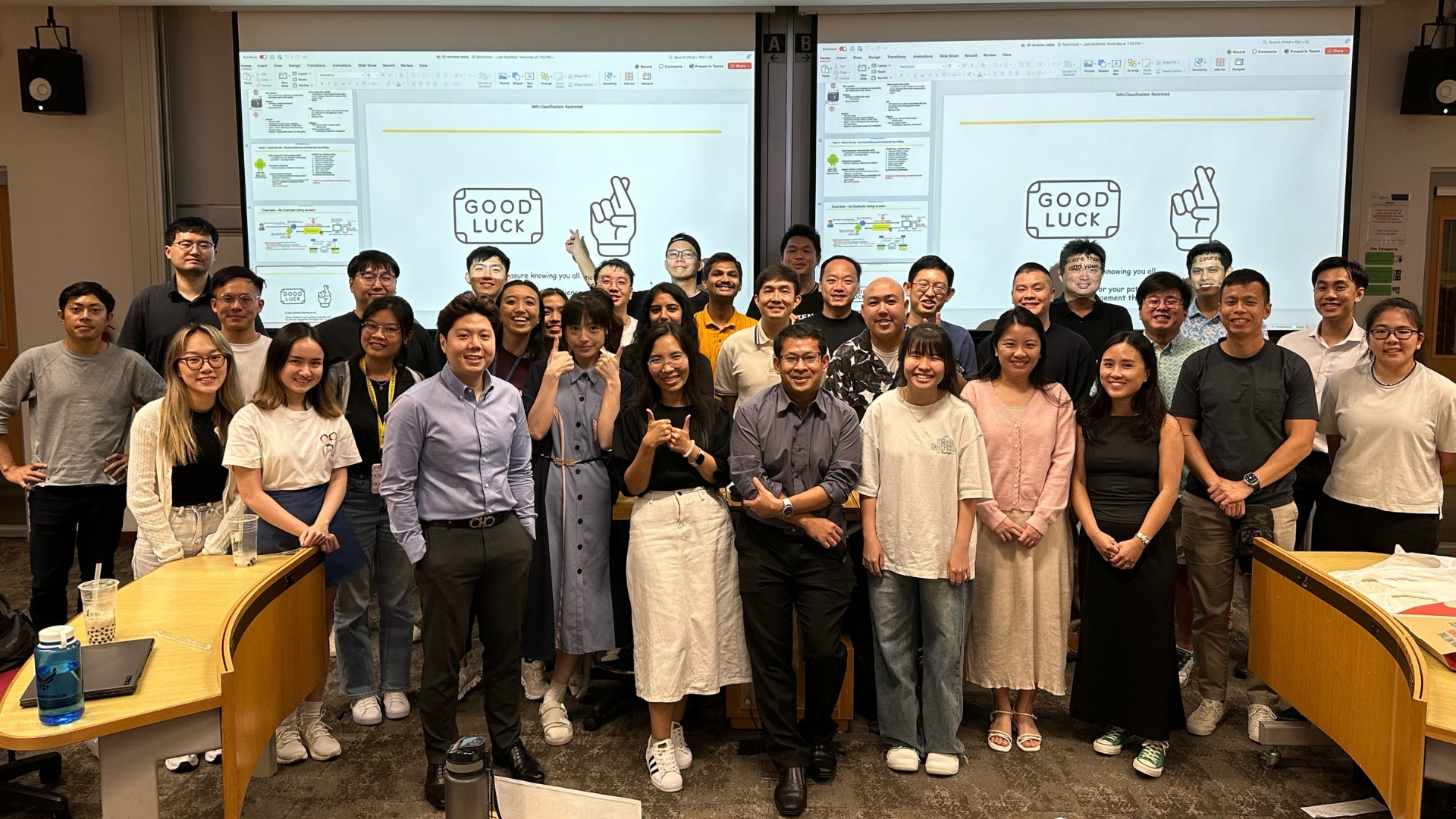
For Assoc Prof Shar (1st row), one of the most rewarding aspects of leading the SMU MITB (Cybersecurity) track is helping to nurture future cybersecurity leaders.
Beyond technical expertise: Developing judgment on usability
For Assoc Prof Shar, cybersecurity is fundamentally about decision-making, which is often performed under uncertainty and has far-reaching consequences. Technical knowledge alone is insufficient.
“Security is also heavily dependent on trade-offs, governance, and anticipating unintended consequences,” he shares. “I want our students to become trusted security decision-makers.”
This perspective, that Assoc Prof Shar hopes to inculcate in MITB students, is grounded by his own experience navigating the gap between research and practice. Early in his academic career, he developed a technically elegant solution that proved difficult for industry to adopt—a lesson that continues to inform his work. He now strives for research that is novel yet practical, with an emphasis on adoptability and usability.
For instance, a real-world challenge Assoc Prof Shar hopes to address is the robustness and explainability of large language models (LLMs) for security applications. He explains that while LLMs are currently used in security applications like vulnerability detection, the end-users’ trust in LLMs is still lacking.
“Imagine if AI tools could identify vulnerable code that looks similar to secure code, accurately explain why it is vulnerable, and suggest robust fixes without hallucinating or overwhelming developers with noise. That would truly transform how we build secure systems, from cloud infrastructure to mobile apps,” he muses.
Preparing cybersecurity professionals for what comes next
As cyber threats evolve and technologies such as AI and cloud computing reshape the digital landscape, demand for professionals with both technical and strategic skills will continue to grow. The SMU MITB Cybersecurity track is designed with that future in mind, preparing graduates for the broader responsibilities that come with leading cybersecurity in organisations in Singapore and across the region.
“I’m driven by the idea that we can develop tools and methods that make our digital infrastructure more resilient—whether that’s by securing cloud configurations, guiding post-quantum cryptography migration, or using LLMs to detect vulnerabilities at scale,” Assoc Prof Shar says.
Sharing advice to up-and-coming talents in cybersecurity, he encourages them to engage with users early, test ideas in the real world, and iterate often.
“Collaboration, feedback, or even sometimes setbacks are not distractions—they are part of the process,” he shares. “Also, stay curious. The intersections between AI and security, business and technology, are where the most exciting ideas often emerge.”