





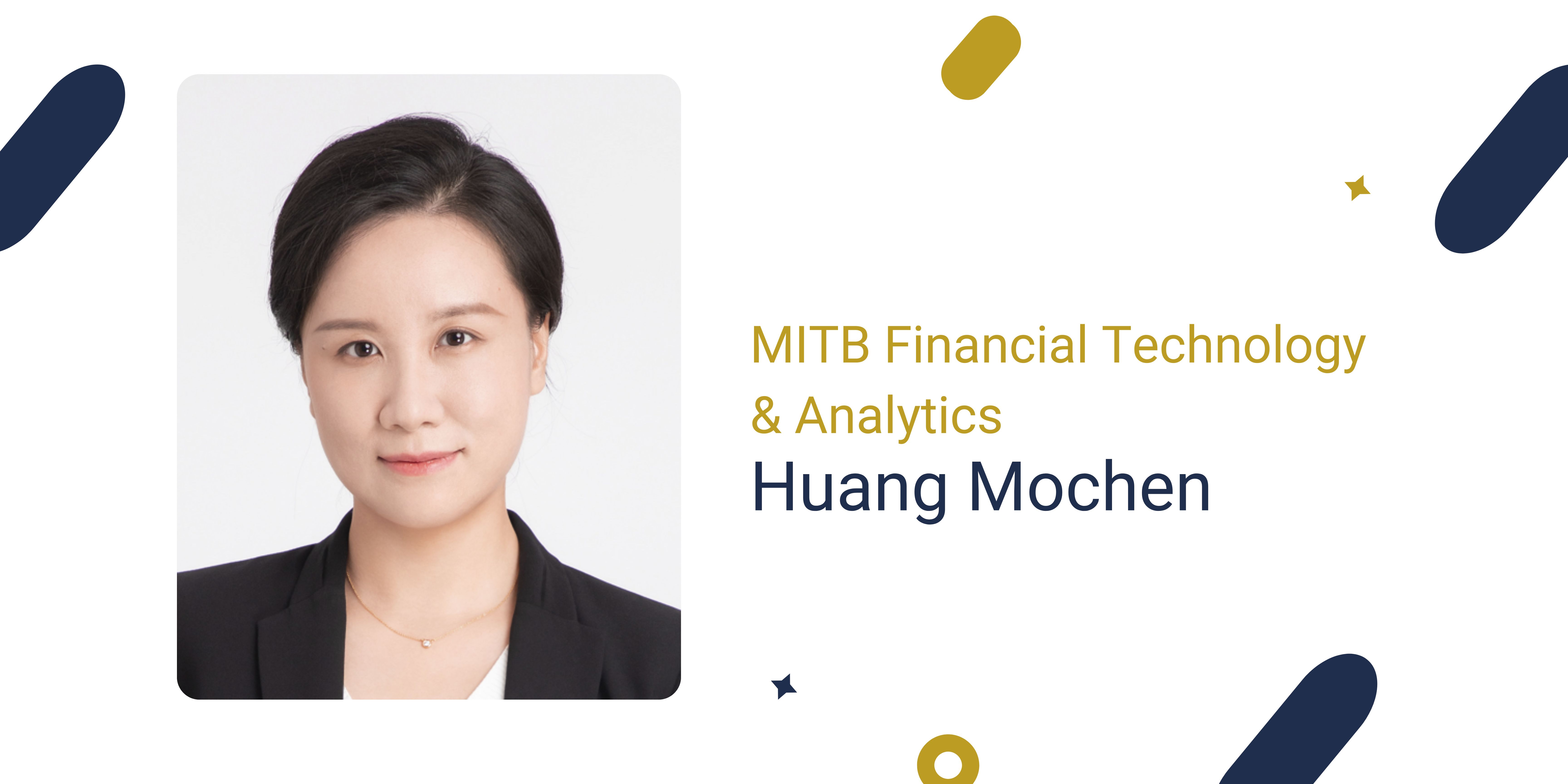
Huang Mochen
Master of IT in Business (Financial Technology & Analytics)
August 2025 Intake
After more than 14 years in banking and financial services, I have worked across a wide range of roles spanning IT project management, quality assurance, PMO, and business development. With a degree in Economics, majoring in Finance, my career has placed me at the intersection of business and technology, supporting organisations at different stages of a bank’s lifecycle from system buildouts to business-as-usual operations.
While experience allowed me to solve problems more efficiently, it also made a limitation increasingly clear. I was very good at managing technology projects, but I did not fully understand the technology at a fundamental level. I could coordinate developers, translate requirements, and keep projects on track, yet many technical and data-driven concepts remained abstract to me. After more than a decade in the industry, I decided to revisit core technology foundations, data analytics, and emerging areas such as artificial intelligence through a structured education pathway.
MITB helped me bridge the gap between my domain knowledge and a more holistic understanding of how systems, data, and business logic work. For example, when I previously worked as a project manager on an interest rate management system, my role focused on delivery timelines and coordination. I understood data flows and ETL processes, but the deeper logic of risk management and regulatory requirements remained unclear. Through the RiskTech and RegTech module, many questions I had carried for over a decade were finally answered. For the first time, I could clearly see how regulatory rules, risk models, and algorithms connected.
Before MITB, I had no coding background at all. Writing requirement documents and working with developers was often slow and frustrating. Through the programme, I learned the basics of Python and how to collaborate effectively with AI-assisted coding tools. While I do not consider myself a programmer, I can now build simple datasets, run analyses, test ideas quickly, and even create MVP demos. Recently, I surprised a hiring manager by explaining that I had built an MVP on my own—something I had never imagined doing before attending MITB.
The Large Language Models and Generative AI module had a particularly strong impact on me. Although it was outside my primary track, MITB’s flexibility encouraged exploration across disciplines. We learned not only the theory behind language models, but also how to experiment with prompt engineering, agentic AI, and rapid prototyping. It helped me connect classroom learning directly to what is happening in the real world.
The cohort experience was equally meaningful. Many of my classmates brought substantial professional experience, which made group discussions practical and grounded. At the same time, I enjoyed mentoring younger students who were just starting their careers. This mix of perspectives made the learning environment both intellectually stimulating and personally rewarding.
During my internship, I joined a local POS company, a subsidiary of Ant International. Stepping back into the workplace as an intern after many years in senior roles was both humbling and eye-opening. Holding a junior title while being one of the more experienced individuals in the room required a shift in mindset. I had to focus on contributing meaningfully without relying on formal authority, and to earn trust through action rather than position.
I was intentional about adding value beyond routine tasks. Drawing on my prior experience, I helped establish a cross-border merchant payment issue resolving mechanism between the Singapore and China teams. At the same time, the technical skills I gained at MITB, such as SQL and Python, allowed me to handle data analysis independently—tasks I once viewed as outside my scope. By the end of the six months, I didn't just survive the internship; I emerged empowered, having successfully rebuilt my professional identity from the ground up.
Dr James Koh had a significant impact on my journey. His Python and Applied Machine Learning courses were demanding yet remarkably accessible, especially for someone with no prior coding background. What made the experience stand out was his thoughtful teaching approach – assignments were built around familiar Disney stories, which made coding feel far less intimidating and surprisingly engaging.
Beyond the classroom, Dr Koh grounded technical concepts in real industry experience. He openly acknowledged that getting stuck is not a failure, but a natural—and necessary—part of working with technology in the real world. His courses pushed us to learn by doing. Beyond the three-hour weekly lectures, we spent countless hours experimenting, failing, debugging, and trying again. By the end of the course, I walked away with more than technical knowledge and gained confidence—the conviction that even when something is difficult, I can figure it out.
While my learning journey at SMU has been immensely valuable, I am eager to bring what I have learned back into the workplace and apply it in real business settings. MITB is a rigorous, highly applied programme. Starting Python from scratch is challenging, but the depth of learning and confidence it builds make the journey genuinely worthwhile.