




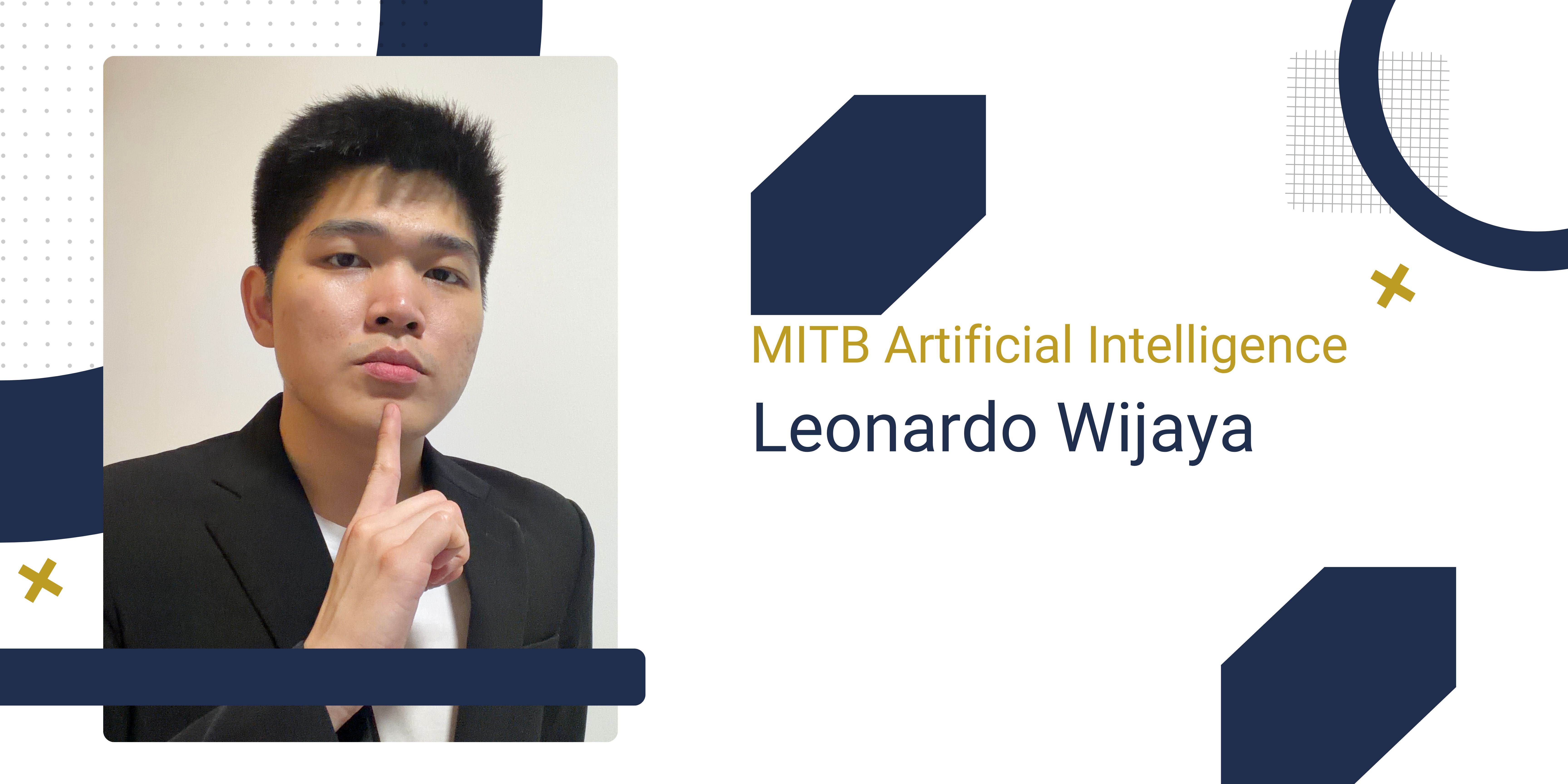
Leonardo
Master of IT in Business (Artificial Intelligence)
Class of 2025
I am Leonardo, an AI Engineer at UBS, and my professional journey has been shaped by a constant desire to understand not just how technology works, but why it matters. I pursued my undergraduate degree in Computer Science at the Bandung Institute of Technology in Indonesia, followed by two internships in Data and AI and three years of full-time experience as a Data Scientist. While this foundation equipped me with strong technical skills, it eventually led me to a pivotal realisation: I had reached a ceiling.
In my previous roles, I was comfortable building models and deploying solutions, but I lacked exposure to the strategic thinking that determines whether technology truly creates value. I understood the mechanics of AI, yet I was often removed from the business rationale behind the decisions being made. This gap motivated me to pursue a professional master’s degree that could help me move beyond execution and into impact.
I chose the SMU Master of IT in Business (MITB) because of its distinct positioning at the intersection of business and technology. Unlike programmes that focus purely on technical depth, MITB promised something I was actively seeking—a business lens. I wanted to learn how AI fits into organisational strategy, how it drives transformation, and how technical decisions translate into business outcomes. MITB delivered on that promise.
What stood out throughout the programme was its emphasis on purpose. Every technology we studied was framed around real-world problems, forcing us to constantly ask: what is this solution trying to achieve, and for whom? This shift in perspective fundamentally changed how I approach AI today.
One of the most impactful modules for me was AI System Evaluation. As AI adoption accelerates, so do concerns around reliability, security, and ethics. This course pushed me to think beyond performance metrics and focus on building systems that are safe, robust, and responsible. It gave me practical frameworks to assess AI systems holistically—skills that are increasingly critical in regulated industries like banking and finance.
The AI Planning and Decision-Making course was a turning point in my professional development. It reshaped how I approach complex problem-solving by introducing me to Operations Research and the realities of solving large-scale business challenges. Many real-world problems in organisations – such as logistics routing, scheduling or resource allocation – fall into a category known as NP-hard problems. Simply put, these are problems where the number of possible solutions grows so rapidly that finding the “perfect” answer becomes computationally impractical as the problem scales.
Before this course, my instinct was always to strive for the 'perfect' technical solution. However, I learned that in a business context, waiting for perfection often means missing the opportunity to act. This module taught me how to bridge mathematical complexity with business utility by designing heuristic-based approaches—solutions that may not be theoretically perfect but deliver strong, reliable results within real-world constraints. This shift in mindset has fundamentally changed how I work at UBS, allowing me to deliver outcomes that are both technically sound and commercially practical.
Beyond academics, the MITB cohort experience was an intellectual melting pot. My peers came from diverse industries, and collaborating with them broadened my perspective immensely. For example, when tackling a problem in the financial technology sector, collaborating with peers from a deep financial background was eye-opening. It shifted my perspective from a purely technical execution to a rather uncommon engineering approach, where the technical solution is deeply informed by the nuances of the financial domain. Learning alongside such a high calibre of peers not only taught me new skills, but it also taught me how to approach a single problem from multiple strategic angles.
During my MITB journey, I also completed an internship at the Monetary Authority of Singapore (MAS) where I designed sophisticated pattern recognition algorithms to identify latent opportunities for stock market analysis. Building a deterministic, high-performance system in such a fast-paced environment deepened my understanding of market dynamics and reinforced the critical role AI plays in modern finance.
Professor Lau Hoong Chuin who taught the AI Planning and Decision Making course, made a profound impact on my academic journey. His ability to make mathematically complex concepts accessible, coupled with his mentorship beyond the classroom, culminated in encouraging our team to submit our project to the European Conference on AI (ECAI) 2025. Collaborating with him on the research paper was an invaluable experience. That experience taught me the discipline and precision required for professional research.
Having graduated from July 2025, I am currently focused on applying the strategic and technical frameworks I learned at SMU MITB in my role as an AI Engineer at UBS. Given the critical importance of security and trust in the financial world, my immediate plan is to deepen my expertise in AI security. I aim to be at the forefront of building AI that is not only high performing but also meets the highest standards of robustness and safety. Long-term, I aspire to lead initiatives that bridge cutting-edge AI innovation with responsible and ethical business practices.
The MITB programme is a transformative bridge for me – one that elevated my perspective from a technical specialist to a strategic thinker, equipped to solve complex, real-world challenges with clarity and purpose.