




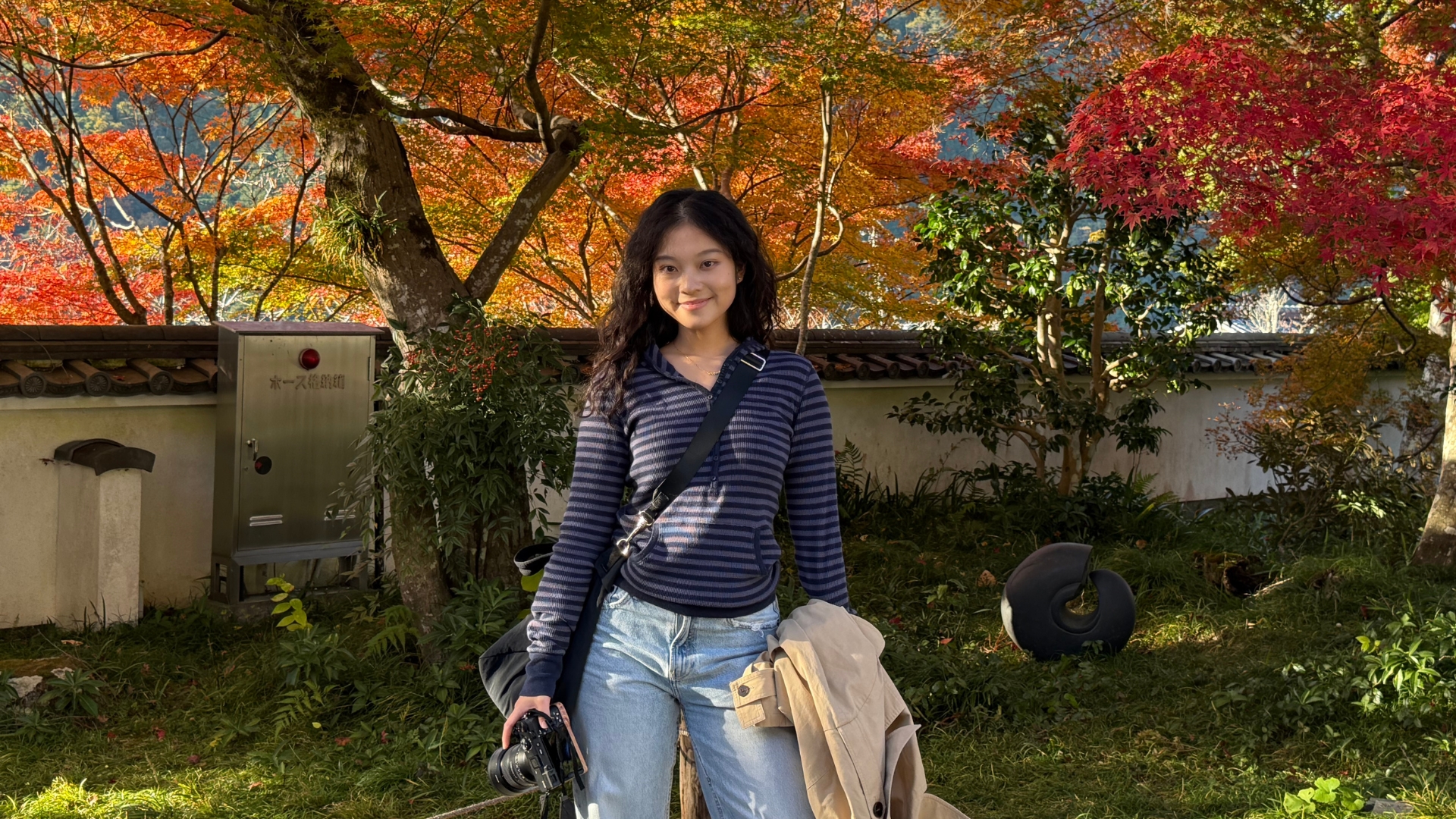
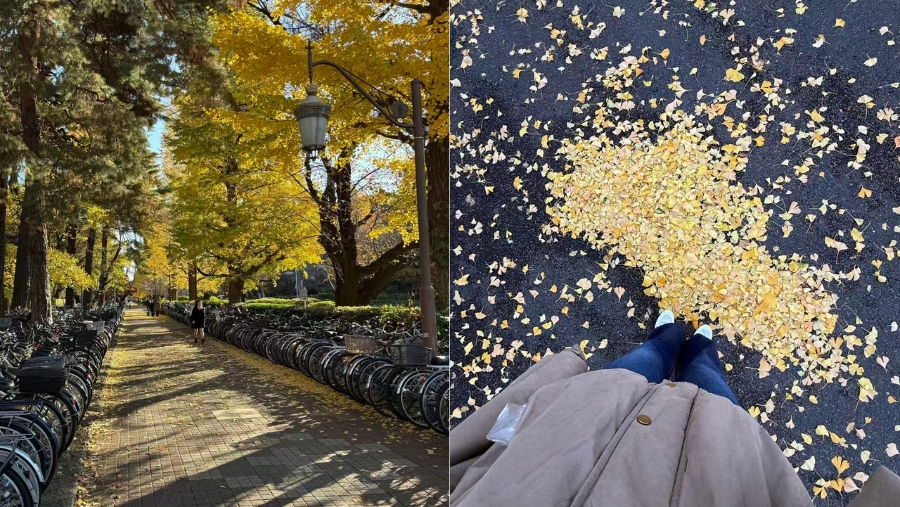
"One of my favourite memories on campus was in autumn, when the leaves of the gingko trees turned bright yellow and fell on the roads, making them look as if they were covered in gold," shares Song Haoyan, a student in the SMU Master of Science in Accounting (Data & Analytics) programme.
For Haoyan, her exchange at Hitotsubashi University in Tokyo was more than a semester abroad. It was an opportunity to experience accounting education through a different cultural and academic lens, and to deepen the global perspective, analytical mindset, and adaptability needed in today’s evolving accounting profession.
Keen to understand how business and accounting are taught in Japan, given the country’s distinctive business culture, Haoyan embarked on the overseas exchange programme as part of the global exposure opportunities available to SMU postgraduate students.
“I wanted to experience a different academic environment from what I was used to at SMU,” she shares.
Seeing accounting through a different academic lens
In Japan, Haoyan experienced firsthand a different way of learning. Stepping into her first seminars at Hitotsubashi University, the shift in classroom culture quickly became apparent.
“At SMU, classes are highly interactive and discussion-based. Students are encouraged to participate actively, challenge ideas, and contribute to class debates,” Haoyan shares. “At Hitotsubashi University, however, I found the teaching style to be more structured and analytical, focusing on theoretical depth.”
The contrast helped Haoyan appreciate how SMU’s interactive pedagogy and Hitotsubashi’s analytical depth could complement each other — strengthening both her technical understanding and her ability to engage with accounting issues from multiple perspectives.
In her accounting classes, Haoyan also saw how data collection and empirical analysis are playing a growing role in accounting research. Through discussions on large public datasets, web scraping, and data processing, she developed a deeper appreciation of how data can be used to examine real business and accounting questions.
This experience deepened her interest in the analytical side of accounting, reinforcing the relevance of data and analytics in a profession increasingly shaped by technology, complexity, and change.
Beyond the classroom material, Haoyan also gained insight into how cultural nuances shaped the way ideas were developed and discussed. For instance, she observed that her Japanese peers tended to express their ideas more indirectly. To navigate this, she adapted her communication approach, seeking clarification outside of class to build a shared understanding.
“As we continued working together, we gradually adapted to each other’s communication styles. I also realised that people often approach the same problem from different perspectives depending on their backgrounds.”
The overseas exchange experience not only broadened her academic perspective, but also strengthened her ability to navigate diverse ways of thinking and working — essential skills for accounting professionals operating across markets, teams, and cultures.
Building cultural fluency beyond the classroom
Beyond her academic experience, Haoyan found warmth in daily life in Japan as she immersed herself in a new culture.
“People in Japan are generally very friendly and considerate, which made daily life feel comfortable and welcoming,” she shares.
A memorable moment for the accounting master’s student was attending a festival at Kunitachi, the quiet town where Hitotsubashi University is located. She found unexpected warmth in the Kunitachi City Festival, as she watched the usually tranquil town come alive with energy.
“Many young people performed on the streets and joined small parades, while food stalls lined the roads. The whole town felt lively and full of energy, and it was touching to see how much people cared about and celebrated their community.”

These everyday encounters helped Haoyan build a deeper sensitivity to culture, communication, and community — qualities that are increasingly valuable for accounting professionals working across borders and diverse teams.
Another favourite moment was experiencing the cinematic seasonal changes on the quiet campus, a contrast to the frenetic pulse of Tokyo’s city centre.
“When it snowed in winter, the warm yellow lights on campus shone against the white snow, making the whole scene look like a postcard.”
Preparing for a global, data-driven accounting career
Ultimately, Haoyan’s semester in Tokyo was defined by a profound shift in perspective.
“Studying in a new country felt like seeing the world through a new lens,” she notes.
The semester abroad allowed Haoyan to connect classroom learning with the realities of living, studying, and collaborating in a different cultural environment. It also gave her an education in cultural fluency that, as she observes, cannot be fully learnt in the classroom.
“One of the most valuable experiences of the exchange programme was interacting with classmates from different countries and realising that people often approach the same problem in very different ways,” Haoyan elaborates.
“Living in another country also allows you to experience everyday life in a different culture, which is something you cannot fully learn in a classroom.”
For Haoyan, the exchange experience was not only about studying in another country. It was about learning to see accounting, analytics, and business through a broader global lens.
At SMU, the Master of Science in Accounting (Data & Analytics) (MSA) programme is designed to prepare students for an accounting profession increasingly shaped by data, technology, and cross-border complexity. Through rigorous learning and global exposure opportunities, students build the technical, analytical, and cultural capabilities needed to thrive in a changing world.