





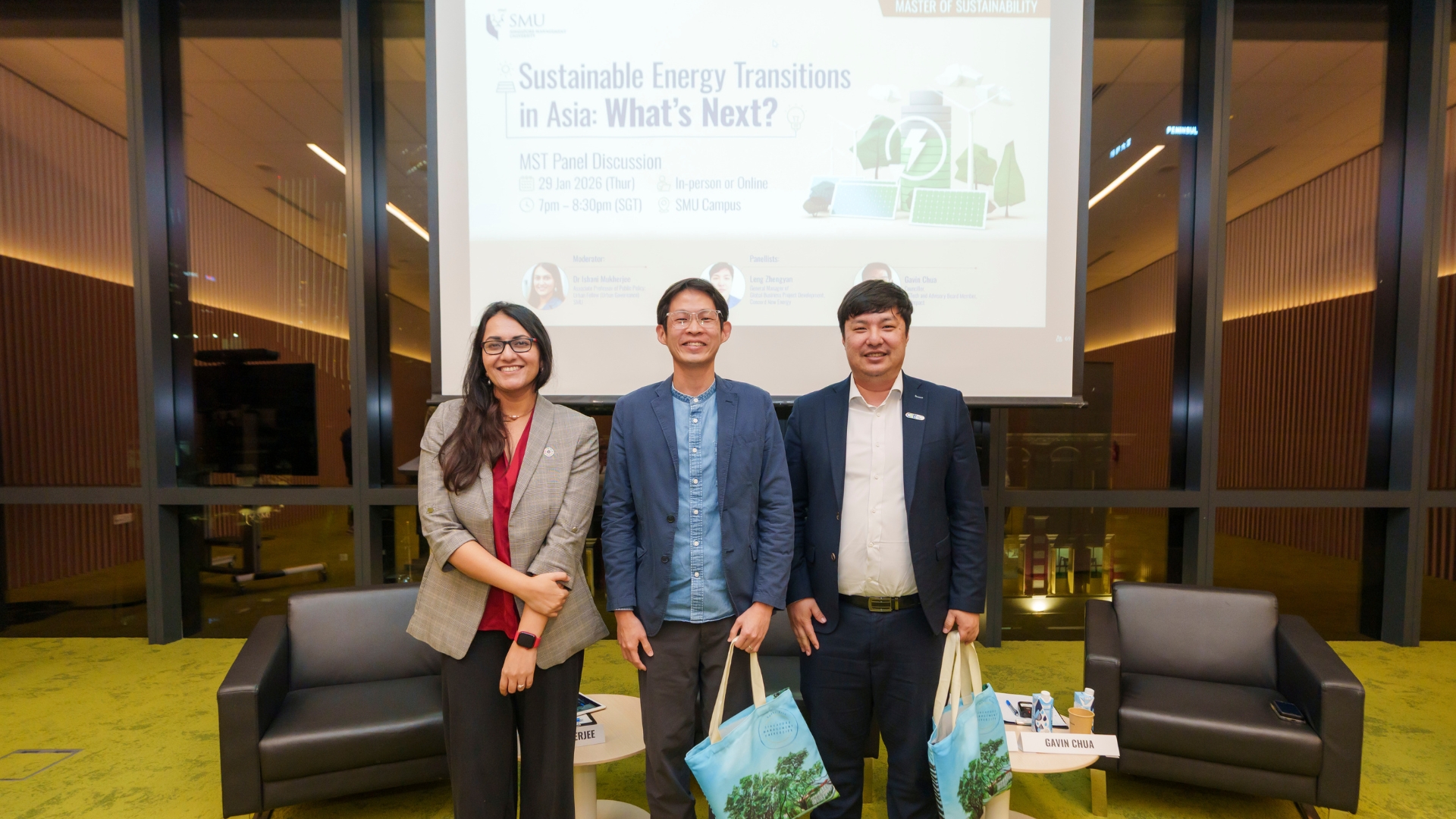
[Featured image: (L-R) SMU Associate Professor Ishani Mukherjee; Mr Gavin Chua, Councillor at SGTech and Advisory Board Member at EB Impact; and Mr Leng Zhengyan, General Manager of Global Business Project Development at Concord New Energy Group.]
Asia’s transition to sustainable energy represents one of the defining challenges of the coming decades. The region accounts for nearly half of global energy consumption, driven by rapid economic growth and expanding urbanisation. As demand continues to rise, governments and industries must balance the need for reliable energy with the urgent imperative to decarbonise.
Navigating this transformation requires professionals who understand not only renewable technologies, but also the policy frameworks, market mechanisms, and infrastructure constraints shaping the energy landscape.
At Singapore Management University (SMU), the Master of Sustainability (MST) programme convenes industry leaders and policymakers to explore these real-world challenges. At a panel discussion hosted by the programme on 29 January 2026, experts examined the opportunities and obstacles shaping Asia’s renewable energy transition.
Moderated by SMU Associate Professor Ishani Mukherjee, the panel featured two industry leaders: Mr Leng Zhengyan, General Manager of Global Business Project Development at Concord New Energy Group, and Mr Gavin Chua, Councillor at SGTech and Advisory Board Member at EB Impact.
Driving progress through policy and partnerships
Across Asia, the transition towards renewable energy is unfolding at different speeds. While many countries face infrastructural and regulatory constraints, strategic policy frameworks and industry partnerships are helping accelerate progress.
In Southeast Asia, Singapore has emerged as an important catalyst for renewable energy deployment through market-oriented policies and regional collaboration.
“Singapore’s approach has generally been that businesses must ultimately be commercially viable rather than dependent on permanent subsidies. The government focuses on creating the right conditions—such as infrastructure, policy support, and sometimes aggregating demand—to help industries grow.”
An example of this approach is the SolarNova programme, which aggregates demand for solar panel installations across public housing blocks and government sites. This approach proved crucial in achieving economies of scale, making these installations more financially viable.
Corporate demand has also played an increasingly important role in expanding renewable energy markets. Technology firms were among the early adopters of corporate renewable power purchase agreements (PPAs), helping to create market mechanisms that enabled off-site renewable energy procurement.
Another major initiative shaping the region’s energy future is the ASEAN Power Grid, which aims to facilitate cross-border electricity trading and enable greater integration of renewable energy across Southeast Asia.
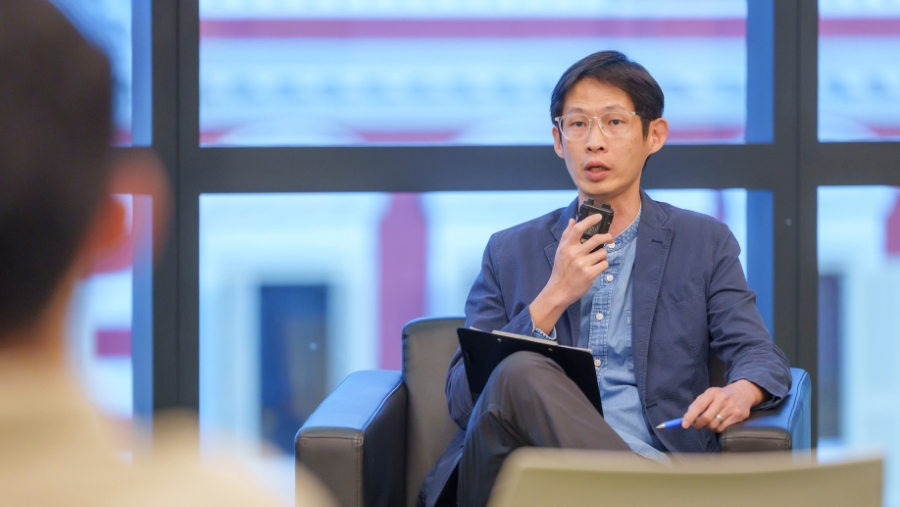
Mr Chua noted that Singapore’s investments in energy interconnectors signal a growing commitment to regional energy collaboration. Large corporate buyers are also driving demand for renewable energy across Asia.
“In 2023, the region saw approximately 10 gigawatts of PPAs—triple the 2020 figure—with the International Energy Agency projecting 670 gigawatts of renewable opportunities across Asia Pacific between 2025 and 2030,” shared Mr Chua.
Understanding how these market structures operate is increasingly important for sustainability professionals working in policy, finance, and corporate strategy. The interdisciplinary approach of the SMU MST programme equips professionals to analyse these complex dynamics—from regulatory frameworks to energy market mechanisms.
Navigating infrastructural hurdles
Despite growing momentum, deploying renewable energy at scale presents significant technical and infrastructural challenges across Asia.
Grid intermittency remains a critical issue, particularly when renewable energy generation does not align with consumption patterns. Addressing this mismatch often requires hybrid energy solutions.
“For example, resorts in the Philippines, Thailand, and Indonesia that traditionally ran on diesel generators now seek solar-plus-battery systems,” explained Mr Leng.
“In Singapore, imported energy must, gradually over a period of three to five years, achieve nearly 100 per cent capacity factor, requiring solar panel capacity of at least seven times than usual, supported by significant battery storage.”
Grid infrastructure limitations can also constrain renewable energy deployment. Vietnam’s rapid solar expansion, for instance, has encountered significant bottlenecks due to insufficient grid capacity.
Despite widespread solar panel installations in the country, weak transmission infrastructure has resulted in curtailment rates estimated at between 40 and 60 per cent in some regions.
Meanwhile, regulatory frameworks can shape how grid upgrades are financed. In the Philippines, developers must fund grid enhancements at each connection point, while limited transformer manufacturing capacity has created supply chain bottlenecks across the country.
These technical and regulatory complexities highlight the need for professionals who can navigate both engineering constraints and policy environments—an interdisciplinary capability that sustainability education increasingly seeks to develop.
Diverse pathways to renewable energy deployment across Asia
Asia’s energy transition is far from uniform. Countries across the region face different economic, political, and technological conditions that shape their renewable energy strategies.
In Southeast Asia, many economies remain heavily reliant on fossil fuels, though solar manufacturing and renewable investments are expanding rapidly in countries such as Vietnam and Malaysia. The Philippines, however, continues to face infrastructure constraints that complicate large-scale renewable deployment.
In South Asia, India has emerged as a major renewable energy market, attracting large investments from technology companies. However, smaller economies such as Bangladesh and Sri Lanka face country credit risk challenges that often require support from multilateral institutions such as the Asian Development Bank.
Northeast Asia presents a different picture. According to Mr Chua, countries including China, Japan, and South Korea have diversified energy strategies that incorporate nuclear power alongside renewables.
At the same time, rapid expansion of manufacturing capacity has created challenges within the solar industry.
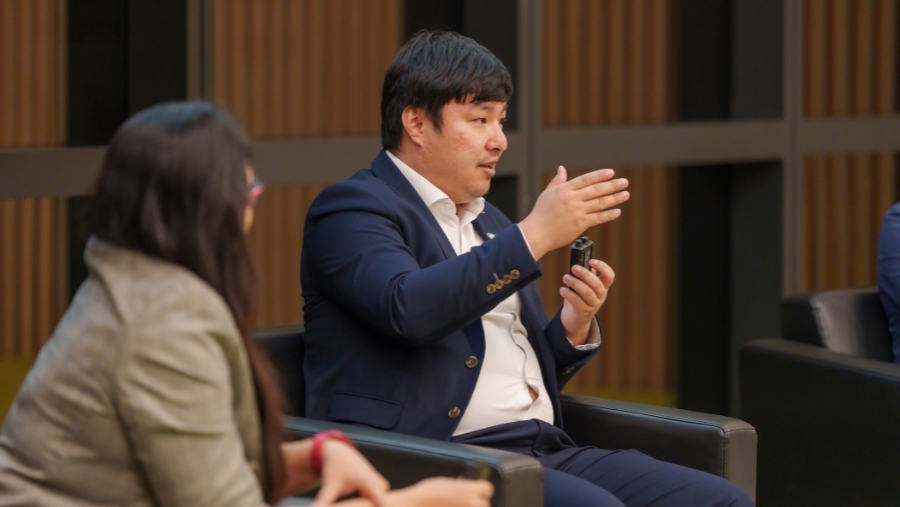
“This is public information: the top five solar panel manufacturers in China have been losing money for the past seven quarters,” Mr Leng remarked.
Oversupply within the sector has intensified competition and accelerated consolidation across the industry.
Emerging opportunities on the horizon
Despite the challenges, both panellists identified promising opportunities that could accelerate Asia’s energy transition.
Mr Chua pointed to solid oxide fuel cells as a potential breakthrough technology that could help address grid limitations by enabling decentralised energy generation.
Meanwhile, Mr Leng highlighted the replacement of diesel generator sets across Southeast Asia as a significant opportunity for decarbonisation.
Solar-plus-battery systems are increasingly able to deliver electricity at a lower levelised cost of energy than diesel generation, creating an economically attractive pathway for renewable adoption in remote or off-grid locations.
Preparing the next generation of sustainability leaders
Asia’s energy transition will require professionals who can navigate a complex landscape spanning technology, policy, finance, and infrastructure.
The SMU Master of Sustainability (MST) programme equips professionals with the interdisciplinary knowledge and analytical tools needed to tackle these challenges—from understanding renewable energy systems and decarbonisation strategies to evaluating policy frameworks and market mechanisms.
Through a combination of academic rigour, industry engagement, and real-world case discussions such as this panel, the programme prepares professionals to contribute meaningfully to sustainable development across Asia.
As the region accelerates its transition towards cleaner energy systems, the ability to bridge technical, policy, and business perspectives will be increasingly critical.
Take the next step towards shaping Asia’s sustainable energy future. Apply to the SMU Master of Sustainability (MST) programme today.