




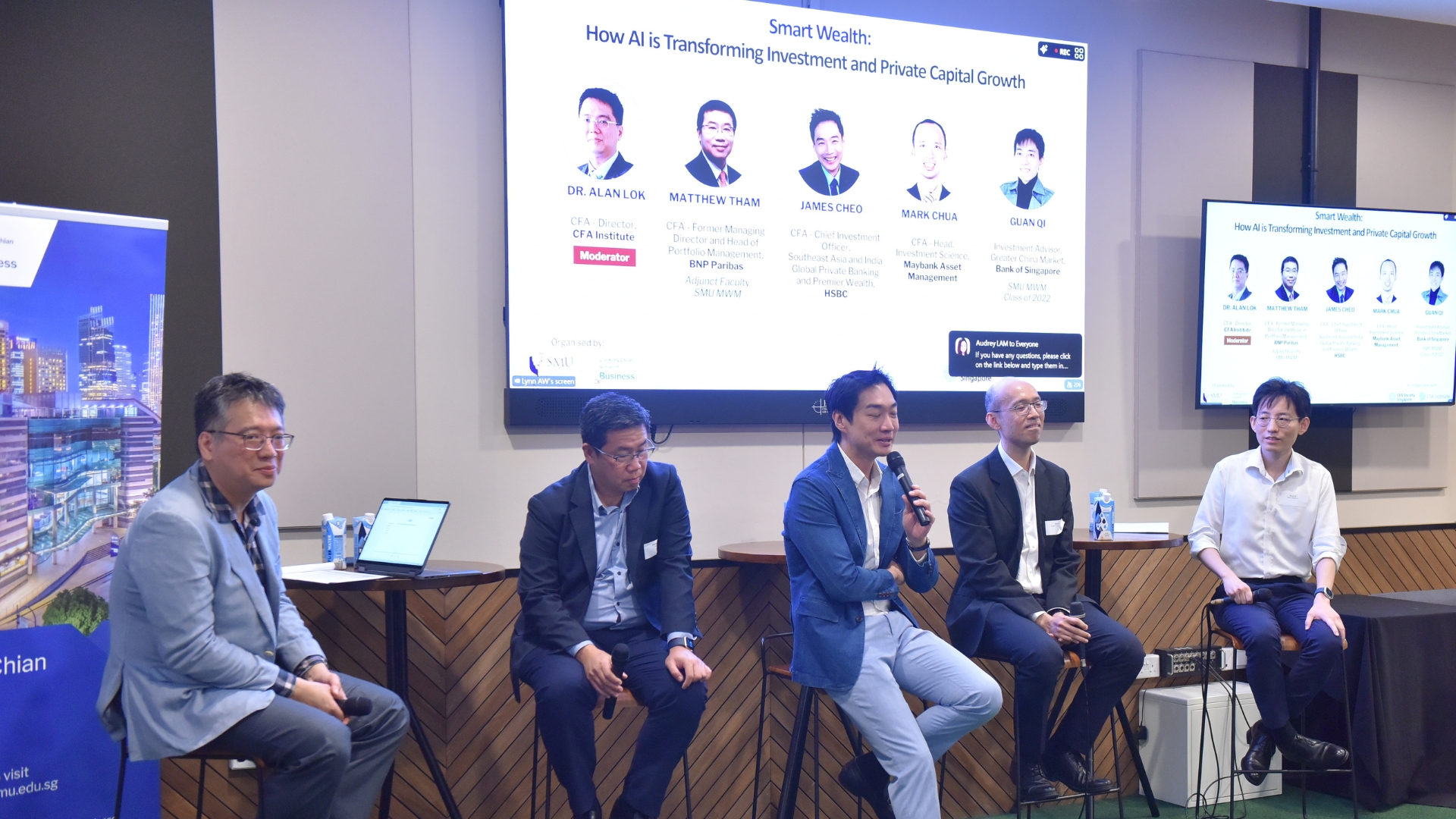
[Featured image: (L-R) Dr Alan Lok, Director of CFA Institute; Mr Matthew Tham, former Managing Director & Head of DPM at BNP Paribas; Mr James Cheo, Chief Investment Officer (CIO) of Southeast Asia and India at HSBC Private Bank and Premier Wealth; Mr Mark Chua, Head of Investment Science at Maybank Asset Management; Mr Guan Qi, Investment Advisor of the Greater China Market at Bank of Singapore]
Artificial intelligence (AI) is reshaping the future of finance, from career prospects, professional expertise, to investment strategies. As the industry becomes increasingly automated and complex, the SMU Lee Kong Chian School of Business, in collaboration with CFA Institute and CFA Society Singapore, convened a timely discussion on 31 October 2025 to explore this evolving landscape.
Associate Professor of Finance (Education) Mandy Tham opened the discourse with compelling market data: the Asia Pacific wealth market is projected to grow from US$27.57 trillion in 2025 to US$39.15 trillion by 2030, with AI integration in wealth management platforms expected to double to almost US$12 billion. She also outlined various PhD research at SMU and real-world applications of generative AI in finance, such as client personalisation and investment research.
“Singapore is a beneficiary of the growth and wealth in Asia Pacific,” Assoc Prof Tham noted, positioning the city-state at the centre of the AI revolution. “A key takeaway for wealth managers and private capital firms is to prioritise Asia Pacific for innovation, catering to the next generation of digitally native clients.”
Following Assoc Prof Tham’s keynote, a panel discussion explored the opportunities and challenges AI presents to the next generation of finance professionals. Moderated by Dr Alan Lok, Director of CFA Institute, industry leaders delved into AI’s real-world applications in private wealth and institutional asset management.
The growing role of AI in wealth management
AI adoption across Asia Pacific is accelerating rapidly, reshaping different segments of the wealth management industry.
Mr Mark Chua, Head of Investment Science at Maybank Asset Management, quipped that his role spans both investment and data science. His team has developed an internal AI-driven platform that scores listed companies, generating qualitative insights on business models and industry positioning.
His work exemplifies how AI is bridging the gap between quantitative and fundamental analysis. “With AI, it’s possible to create detailed research reports at scale.”
AI’s impact on client-facing roles is equally profound. Mr Guan Qi, Investment Advisor of the Greater China Market at Bank of Singapore, shared how AI has streamlined his work. Previously, he had to sift through numerous reports to understand unfamiliar topics to address client queries. Now, he leverages AI for summaries, enabling him to advise his clients more efficiently.
Beyond productivity, AI is transforming strategic decision-making. Mr James Cheo, Chief Investment Officer (CIO) of Southeast Asia and India at HSBC Private Bank and Premier Wealth, shared how one sovereign wealth fund uses agentic AI to combat groupthink in investment committees.
“They created CIO personas with diverse traits to offer different perspectives,” he revealed. “These personas can analyse past data and identify mistakes, ensuring a more objective decision can be reached.”
Bringing these developments into perspective, Mr Matthew Tham, former Managing Director & Head of DPM at BNP Paribas, outlined the three stages of AI adoption in portfolio management:
- Early adoption drives cost efficiency and productivity.
- AI becomes embedded in core processes of the institution.
- Through agentic finance, AI models are trained to recognise nuances and make recommendations accurately.

Why the human touch still matters
Despite AI’s capabilities, the panellists unanimously emphasised that human judgement remains irreplaceable.
Mr Tham articulated this distinction powerfully, “You can never avoid behavioural finance—greed and fear. When the market is overrun, the AI system wouldn’t know. Only professionals with years of experience like myself can recognise the signs.”
Meanwhile, Mr Cheo introduced the concept of “three highs” essential for thriving in an AI-driven world: high tech, high trust, and high touch. “With AI, you can commoditise IQ. Everyone can be smarter with ChatGPT,” he explained. “What sets people apart is EQ. To thrive as an individual or a company, not only do you need to be tech-savvy, but you also need to maintain a high level of trust and human touch.”
As AI agents become more sophisticated, Mr Chua highlighted a critical risk management concern: agentic AI may be vulnerable to malicious code that could compromise data. He added this concern has led to the new field of AI governance, creating job opportunities focused on managing and monitoring AI agents within organisations.
Preparing for an AI-driven future
Amidst the increased adoption of AI in finance, the panel discussion also addressed employment opportunities for young graduates.
Mr Tham acknowledged the challenge, saying, “Goldman has predicted that with AI, the banking world will lose six to seven per cent of its manpower.”
As such, Mr Guan suggested focusing on roles requiring human touch, creative work, or highly specialised technical expertise.
Meanwhile, Mr Chua emphasised the importance of accelerating one’s learning rate. “Use AI to learn new and different subjects. Turbocharge your learning with it.”
Mr Cheo remained optimistic about human ingenuity, especially among young people. He advised students to “use the brain of an AI, but always retain the heart of a human.”

All in all, the panellists had a clear consensus: technology should enhance human capabilities, instead of replacing the foundational learning that develops critical thinking and professional judgement.
Educational institutions like SMU are adapting their curricula to prepare students for an AI-augmented workplace. As Assoc Prof Tham put it succinctly in her opening keynote, “We need to pivot and reimagine education to ensure employability for our graduates in the age of machines.”
Ready to lead in the age of AI? Explore how SMU’s postgraduate programmes are equipping future-ready finance leaders to drive impactful outcomes in an AI-driven world: